
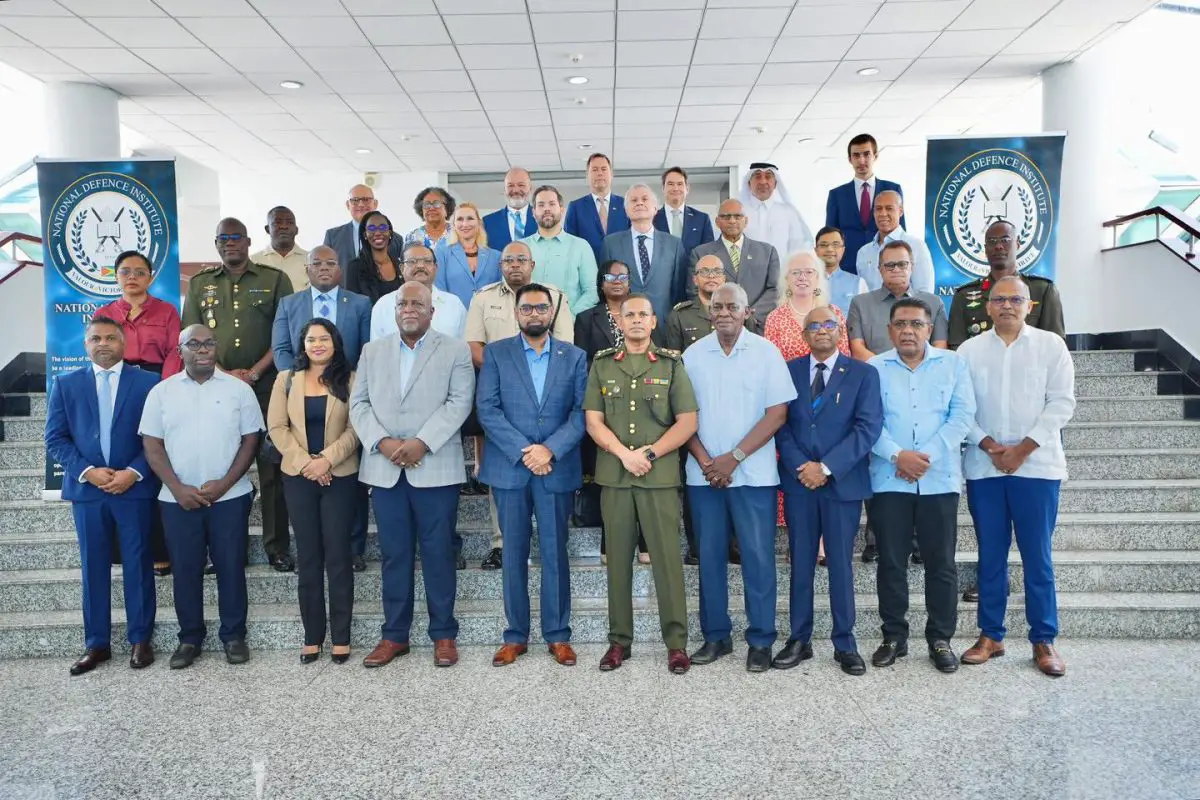
The Guyana Defence Force’s National Defence Institute (NDI) was launched yesterday with the aim of providing specialised and accredited academic training on security issues utilising a wide array of local and international experts.
While housed at the University of Guyana, Turkeyen campus, at which classes will commence next month, the institute will be an independent entity, drawing its teaching pool from experts at home, the region, and internationally, with immediate plans for the training of security and civilian persons on addressing cybersecurity threats, and an analysis of the threats that gangs pose.
“The National Defence Institute we launch today. It’s not just another training institution. It is integral to our national defence strategy and our regional defence strategy. The institute is a crucial part of building capacity and expertise within our national defence architecture,” President Irfaan Ali said at the event to mark the launch which was held in the Lula Room at the Arthur Chung Conference Centre, in Liliendaal, Greater Georgetown.
“The institute will be expected to provide training to a wide range of stakeholders, including the private sector and students. Defence is everybody’s business, and therefore, this institute must be geared towards the training and utilising [of] the inputs of various stakeholders. The institute is designed to be a centre of excellence, a place where the leaders of tomorrow’s defence security architecture will be shaped. As I’ve said before, our vision for this institute is not limited to the borders of Guyana. We aim for it to become the region’s premier institution for defence studies, attracting talent and expertise from across the Caribbean and beyond,” he added.
The NDI would be working closely with the William J. Perry Center for Hemispheric Defense Studies, which is a United States Department of Defense institution; the Caribbean Regional Security System (RSS); and the Caribbean Community’s Implementation Agency for Crime and Security (IMPACS).
The president said that the institute will be linked to Caricom’s RSS and will serve as an academic research institution, producing action plans and analysis of threats and challenges facing the region.
“The National Defence Institute is a regional institute, and within a short time period, we want this to be the premier intelligence defence security agency in the region. We want this institute to be an institute that will be training all our strategic thinkers in defence and security. This institute will be the sister institute of the National Defense University Perry Center that will help them to train persons within CARICOM, South America, and Central America. So the time dynamism of this institute will be interesting and will be evolving.”
A number of issues affecting Guyana and the Caribbean will be researched and analysed and four times a year there will be reviews published on matters such as migration patterns, gang violence, natural disaster impacts and their prevention.
Central hub
In March of this year, while delivering feature remarks at an award presentation ceremony for the University of Guyana’s Institute of Human Resiliency, Strategic Security and the Future (IHRSSF) that was bestowed by the 2023 Perry Centre for Hemispheric Defense Studies Award for Excellence in Security and Defense Education, Ali had announced that plans were on stream for a NDI here.
Yesterday, Ali said that the NDI’s launch was also part of a larger effort aimed at protecting this country’s national interests and safeguarding the region against every threat, particularly the safeguarding of sovereignty and territorial integrity.
Guyana, he pointed out, was subject to threats to its territorial integrity from the time it became an independent nation in 1966. “These challenges have demanded a continuous focus on the defence of our nation. Defence is no longer an option. It is an essential requirement for all those who will play a role in shaping our national defence and security architecture, it is essential that we equip our leaders with the knowledge and skills necessary to address threats and challenges to national defence.”
However, given the technological advancements over the years, he noted that threats are no longer confined to traditional areas. “The threats we face today are not limited to the conventional challenges of border disputes and territorial insurgence.”
Consolidate
The Head of State said he is grateful that the NDI will have as its Assistant Director, a technology specialist in Dr Seon Levius. “Countries like ours must be able to consolidate our technology package within the region. It makes no sense for all of us to be operating on different platforms and different software and so on. We have to integrate the technology. We have to share the technology, and we have to be able to use technology that is relevant to the period in which we’re operating.”
Pointing to the influx of gangs and gang-related crimes in the Caribbean, Ali stated that it has not been strategically determined from the criminal networks and enterprises, which gangs are operating “within our region and our country.”
“For a matter of fact, those who are aware of the way gangs operate will know that simple things like tattoos and symbols can give an idea of the magnitude of gangs, different gangs, and the complexity of those gangs that are operating in our society. And this is a threat for the region and a threat for us. If we do not, in an analytical way, get to the bottom of this, our small societies will be faced with immense danger.” Ali cautioned.
“The nature of security threats has evolved dramatically and encompasses a range of non-traditional threats that require a broader understanding and a more versatile response. Natural disasters, for example, can cripple a nation’s infrastructure and economy, posing a serious threat to national security. The impacts of climate change are becoming more pronounced, necessitating a comprehensive approach to disaster preparedness and response. Defence studies and defence strategies must, therefore, encompass environmental security,” he added.
NDI structure
Director of the institute, Dr Randy Persaud, gave an outline of the NDI and disclosed that the first batch of students will begin studies next month.
“The main objective is to provide reliable and useful knowledge that can be employed in making national security policy and also provide training that will have direct impact under which those services are provided,” he said.
Overall he said the NDI hopes to also bring greater synergy between the government agencies here in Guyana, given that they operate under different mandates. “We want more interoperability more direct communication; vertical and horizontal communication from key agencies,” he said.
The NDI Director pointed out that while classes will be held at a building at UG for now, land has already been identified to build a dedicated structure for the institute. “We will build a brand new building. It is only at the conceptual state right now,” he said while emphasising that the institute “will be an independent entity on to itself, although we will cooperate with UG as we are right now.”
The UG’s registration and grade portal will be used in the interim until the NDI has its own and the first class commences in October, although a start date has not yet been identified.